5 Reasons Your Pool Website Isn't Converting Leads (And How to Fix It)
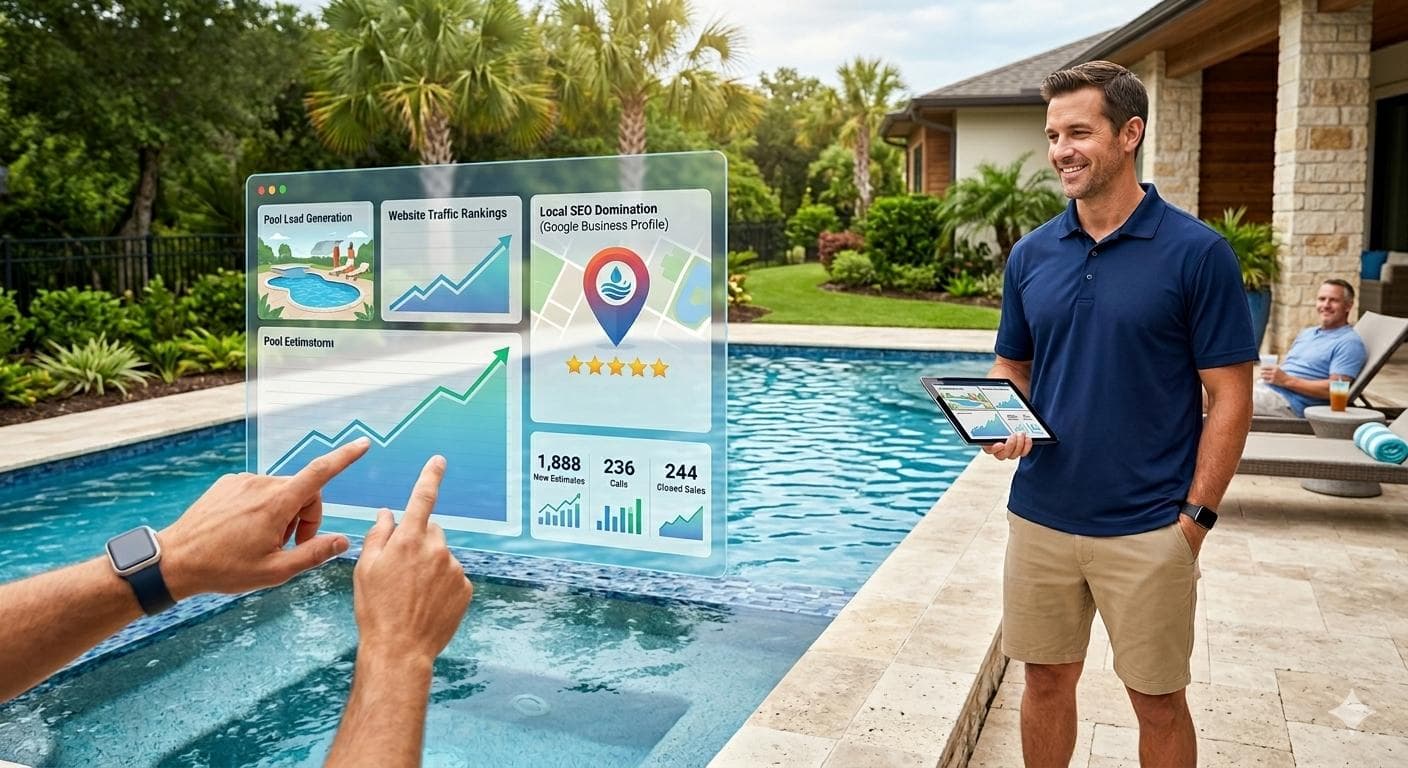
You’ve invested in your online presence. You’re likely running PPC campaigns for pool company and targeting those data-driven social media segments. Perhaps your SEO is even working well enough that your traffic metrics are up year-over-year. You can see people are visiting your digital showroom.
But despite the traffic, the phone isn’t ringing for a free design consultation. The submission forms for a custom quote are empty. Your website has become a beautiful, expensive digital brochure rather than a high-performance lead magnet.
You are not alone. This is a common bottleneck for many custom pool builders and backyard renovation companies.
The truth is, having traffic is only half the battle. If your website is a dead end, all that traffic is a wasted investment. A website that converts traffic into leads is the cornerstone of any successful digital marketing system. It converts casual browsers, dreaming of a backyard transformation, into qualified prospects willing to invest six figures.
Here are the top five reasons your pool builder website isn’t converting leads, along with actionable steps to turn it around.
1. Lack of a Prominent, Clear Call-to-Action (CTA)
The primary goal of every page on your website is to tell the visitor what to do next. If you don't define the journey, they won't take it.
The Problem: Many pool websites make visitors work too hard. The only place to find contact information is hidden at the bottom of the "About Us" page, or worse, the contact button is the exact same color and size as every other secondary menu link. A visitor might read your "About" story, get distracted, and bounce without ever realizing they could request a consultation with a single click. Every page they visit without a prominent CTA is a missed lead capture opportunity.
The Solution: You need a single, primary call-to-action that stands out. For a pool company, this is usually:
Get a Free Design Consultation
Request a Custom Quote
Book Your Backyard Evaluation
This CTA button must be:
- Prominent: Above the fold on every single page, usually in the top-right corner of the menu bar.Contrasting: Use a color that is unique to the rest of the page palette. If your menu bar is blue, use orange or gold for your button.Actionable: Use strong, verbs. Instead of "Contact Us," use "Start Your Dream Pool Build."Repeatable: Have the same CTA button throughout the content of every service page, especially at the end of key informational sections. Give the user multiple chances to say "yes" to the next step.
Don’t forget Review Management here, too. A secondary, but critical, CTA on your homepage or footer can be "Read Our 5-Star Reviews" or a direct badge link to your Google Business Profile with active reviews. Positive social proof is a silent CTA that increases the conversion rate.
2. You’re Selling a Dream, But Showing a Nightmare (Visuals Matter)
In the custom pool industry, you aren't selling concrete or fiberglass; you are selling an aspirational lifestyle and the dream of a private oasis.
The Problem: Your visuals are the fastest way to build trust or destroy it. If your portfolio features grainy, low-resolution, or smartphone photos, or worse, relies heavily on generic stock images, potential clients will assume your craftsmanship is equally poor. Stock photos look generic and lack local relevance, signaling to a savvy homeowner that you don’t have enough finished projects of your own to showcase. In the era of high-definition displays, visual storytelling is paramount.
The Solution: Invest in professional, visual storytelling of your finished backyard renovations. Your portfolio should feature:
High-Resolution Photography: Every gallery image should be sharp, vibrant, and perfectly exposed, showing the sparkling water and intricate deck details.
Professional Video Walkthroughs: A 60-second video showcasing the finished flow of a project—integrating the custom pool, spa, waterfall feature, and landscaping—is exponentially more engaging than text. This captures the user and increases dwell time, which is a powerful signal for local SEO.
Before-and-After Transformations: Show the power of what you can do. These images are highly shareable and create an immediate emotional connection with homeowners who are looking at their own empty dirt lot.
Consistent Geotagging: Use geotagged metadata in your image files to signal to Google’s algorithm exactly where your quality work is being done.
3. Slow Page Speed and Lack of Mobile Optimization
Homeowners dreaming of a pool renovation are usually doing their research from their phones. They are scrolling through visual inspiration while waiting in line or relaxing on the couch.
The Problem: Google operates on a mobile-first indexing system. If your website is slow on mobile, or worse, requires the user to pinch-and-zoom to read the menu, you are actively driving away leads at the exact moment they start dreaming of a renovation. A website that takes longer than 3 seconds to load on a 4G connection is already a conversion failure. Slow performance increases your bounce rate, which can penalize your rankings and sabotage all your other PPC and SEO efforts.
The Solution:
Implement Responsive Web Design: Your site must dynamically adapt to any screen size (desktop, tablet, or phone) without compromising usability. Menus must become clickable dropdowns and visual content must stack naturally.
Optimize Images: Compress all gallery images without sacrificing quality (as you did with that 3.5 MB file!). A few fast-loading high-quality images beats a slow gallery of 20 unoptimized ones.
Minify Code and Use Caching: Streamline your website’s code and utilize browser caching to make repeated visits instant.
Use AI Chatbots for Immediate Interaction: If you can’t answer the phone 24/7, integrate an AI Chatbot. They can instantly engage with a lead, capture their information, and even answer basic questions (like financing options) at 11 PM when your team is off. This improves the user experience (UX) and keeps the lead warm.
4. No Clear Value Proposition or Lack of Topical Authority
Homeowners doing their research will usually have open browser tabs for 5 to 10 competing pool builders. If they can’t figure out what makes you different in the first few seconds, you lose.
The Problem: Many pool company websites use generic language like "Quality Pools Since 1995" or "Experienced Custom Pool Builders." This is fine, but it doesn't give a visitor a compelling reason why they should choose you over the other nine options. If your site lacks deep content detailing your process, material choices, or unique expertise, you appear to be another generic contractor.
The Solution: Define your unique value proposition immediately on your homepage. What is your "blueprint" for success?
Are you the local expert in custom fiberglass installs? Say that.
Do you offer 100% in-house financing? Feature that.
Do you specialize in difficult, complex hillside terrains? Make that your main value pitch.
Back this up by building topical authority through a data-driven content strategy. Feature robust, entity-based blog posts and case studies (like your optimized SEO blog). Detail exactly how you handle swimming pool installations, the benefits of custom gunite pools over fiberglass, or specific project spotlights in the cities you serve. This proves your E-A-T (Expertise, Authoritativeness, and Trustworthiness) to both the homeowner and to Google.
5. A Long, Complex, or Intimidating Request-for-Quote (RFQ) Form
The Primary conversion mechanism for almost every pool builder is the consultation request form. This is your core lead magnet.
The Problem: You are asking too much, too soon. A homeowner who is just beginning the "backyard transformation" dream is likely not ready to tell you their detailed budget range, desired start date, or exact material choices. A multi-step form with 15 mandatory fields (like social security number for financing, specific lot dimensions, etc.) is a lead-killing machine. Each additional form field can reduce your form completion rate significantly.
The Solution: Optimize your primary lead capture form for speed and efficiency:
- Keep it Minimal: You only need four pieces of information to turn a visitor into a lead: Name, Email, Phone Number, and optionally, a brief text box for "How Can We Help You?" or "Service Interest."Use Conditional Logic or Progressive Profiling: If you need more details, use conditional logic so additional fields only appear once the core contact information is submitted. This uses progressive profiling to make the form feel smaller.Clear, Submittable Button: The final button shouldn't just say "Submit." Use a more encouraging CTA like "Request My Free Design Plan."
Conclusion: Stop Throwing Money Into a Hole
As a custom pool builder, your website is your best salesperson. It’s working 24/7, even when you are in the trench or on the job site. But a website isn't a static asset; it’s a living system that needs active management.
Don't let your digital investment be a money pit. The digital landscape—with AI chatbots, mobile-first indexing, and data-driven marketing—is shifting. But the blueprint for success always remains the same: create a cohesive, trust-based user experience that seamlessly leads your prospects toward the next step.
If you are ready to reclaim your weekends, stop guessing, and build a cohesive system that grows your business, let Pool Bros Marketing help. We don’t just handle traffic; we build the optimized web design, Local SEO, PPC, and Review Management systems that generate qualified pool leads and keep your pipelines filled.
Related Articles
How to Get More Pool Leads: Optimize Your Google Profile
From claiming your listing to managing 5-star reviews, learn the exact steps pool contractors need to take to optimize their Google profile and get more leads.
How Can Your Pool Company Dominate Local Search in 2026?
Stop losing $100k contracts to the competition. Discover the 2026 blueprint for pool builders to dominate local SEO, leverage AI tools, and keep your pipeline full year-round.
Why Does Your Pool Company Need A Better Social Media Marketing Strategy?
The secret to that 23% sales increase isn't just luck; it’s the result of a data-driven approach to Social Media Marketing for Pool Companies that targets homeowners at the exact moment they start dreaming of a backyard renovation.
Want These Results for Your Pool Company?
Book a free strategy call and let's talk about how we can grow your business.